Friday, April 20, 2012

NCIS, My Love

It started while I was looking around for distraction.  I didn't mean to fall in love.  Just a little fling, a little dalliance to pass the time after work, after my neurons were stretched out like dry rubber bands, having seen clients all day.  Just poking around the recent postings on On Demand, not even the casual encounters, just the television series.  It was all innocuous. I'd gotten tired with my off and on affair with CSI, CSI Miami, CSI New York;  it had gone on for years, and I'm not happy to admit it.  But I just couldn't do it anymore, with the same old crimes, the same old cities, night after night.  I just couldn't take it anymore, all right?  Alright!?

It was probably the international flavor, the tres exotique quality that finally drew me away from CSI.  It felt like a bigger world with NCIS, and then her friend, NCIS: LA, was like a Moroccan fashion model.  It just kind of happened, and now six seasons later...well, we haven't made it official, but it's definitely not a one-nighter.

I'm not feeling like I have to defend myself, but I do want to explain.  I need to explain.  I need you to understand me.  And not judge.

I love the international thriller.  It's one of my favorite categories.  I love the Bourne movies, the James Bond movies.  I even liked "The International," although surely Clive Owen is the J. Edgar Hoover of Hollywood.  How else do you explain his success except for having bugged many producer's bedrooms?

And I also love stories of functional ad hoc families.  I watched all of "Buffy the Vampire Story," and all of Joss Whedon is pretty much centered on these kind of groupings, which is more or less the story of my generation.  Adrift from conventional moorings, coming together in alleys and desert towns, forming societies out of the wreckage of the old, not yet coalescing into a new, integrated structure.  That's me and mine.

So!  NCIS, with less fan boy vibe, revolves around similar families but in particular work settings.  But the tension and rough love is still there, the backing-each-other-when-the-chips-are-down, the humor and the functional dysfunction.  Then add the involvement-with-world-affairs-and-important-stuff, and how could I refuse that third drink?

The attraction of these shows, maybe all procedural shows, is a ritualistic one.  A procedure is followed in each episode;  the same arc with inflections, riffs, and different textures...but always the same arc.  Sometimes there's a larger arc that helps hold the smaller stories, and those, like the meta arc of the X Files, are really what I love.  They are like the huge science fiction novels I used to get as a kid, thick like a massive sandwich, taking forever to get through, holding one's mind in a warm, directional embrace that bridges the childhood cultural ice fields of crevices and brittle surfaces.  With the broken suburban narrative of youth, these big, multi-faceted, and ultimately integrated stories, that moved from chaos to order, from confusion and disorientation to resolution and transformation (or at least clarification), can't you see why I was primed for this affair?

My life has a lot of inelegant and geometrically lumpy arcs, clients moving forward generally, but with many curly cues and wavy lines.  Not to mention my own, more faith-based arc.  So exposing myself to these matmatically luscious designs, episode after episode, and then savoring the different paint schemes while my social network of add ons and ad hocs is reflected without ridicule--it has a saluatory effect on the general background anxiety of modern life.  You know?

We have to surrender to our loves.  To try to stuff our love into prescribed forms, only cavorting with Masterpiece Theater, or on the other end, teenage slasher films, it distorts you, it twists you like a metal bar propping up a tank.  So I declare it:  I'm in love with NCIS (and her slutty NCIS: LA friend--don't tell her).  It's a modern love.  It's maybe a post-modern love.  It cuts against across my idealized identity.  It exposes shame, blame, rage...well, not rage, actually, a slight blush maybe.  Ok, that came from my dream last night.  Sorry.

So don't judge me.  Love me.  And my darling NCIS(s).

Sunday, April 15, 2012

"The Cabin in the Woods": Negotiations with the Old Gods

(Be Advised - SPOILERS)

We just set off, after a lazy Sunday morning, to see Joss Whedon's new film (as writer and producer), "The Cabin in the Woods," a film that gets odder in the aftertaste than in the viewing. Something like "Blue Velvet" is odd all the way through, both self-consciously and at the level of primary process. I often refer to that opening scene of the father's heart attack and the suburban lawn filled with savagely waring ants--that's so rich and apparent. But "Cabin" inserts or layers on the oddness at different points, and then in reflection; as I think more about it, its multiple and conflicting levels stand out more and more. It's an odd film.

At one level, it's a very clever wink-wink, nudge-nudge, postmodern deconstruction of teenager horror films (are there adult horror films? Heather says there's some: "They are much more psychological--that piece is a big part." So.). Its topic, at the apparent level, is the meta level of how these films are constructed and executed. The puppeteers who are usually behind the screen--the film makers--are put in the film, as an organization tasked with constructing these rituals of the punishment of youth, in order to keep the "Old Gods" from rising. It's a yearly thing that, in the modern context, is run by high tech, but serves the same purpose as tossing a virgin in a volcano. It doesn't then blow and ruin everything.

The ritual itself has become technological, and therefore bloodless, as the ritual priests (here, dressed in white like doctors) flick switches and watch on multiple screens, able to manipulate the characters to satisfy the rather rigid requirements of the Old Gods: one whore, one jock, one mental type, one joker, and one virgin (the virgin must be left for last, and her death is optional, not required). And they must be "punished for transgression," which seems to be a necessary form, though more honored here in inadvertent action than in intention of the characters. As the control room guard says (to paraphrase), "Isn't this a setup?" It is, and is supposed to proceed according to ritual form.

It doesn't. Surprised? It also doesn't come off at any of the other ritual sites in the different nations (though it seems it's more cultural groupings than nations per se), which puts pressure on the American team to pull through and finish the ritual. It is more or less on track until the three remaining kids--the virgin, the jock, and the brain--are driving out the entry tunnel, and it has not been, as is proscribed, collapsed. Some message never came through, and for some reason, "power was rerouted from upstairs," (as the explosives techs say later). Their escape is not sealed until the last minute.

So things are not going to plan, all over the world, with this ritual negotiation with the Old Gods. Then it gets worse as, at the celebration party at the ritual control room, they learn that the joker (a smart stoner kid named Marty) is not dead, and shows up to save the Virgin from the head Pain Worshiping Backwoods Zombie Family leader. They find a way into the complex of the ritual engineers, evade the guards, and when cornered in a control room, hit the Big Red Button and open up all the (clean, modern, stainless steel) containment cases, letting out humanities collected nightmares loose into the (clean, modern, stainless steel) innards of the facility. Blood and guts and horrors tear the place and its working stiff staff to pieces.
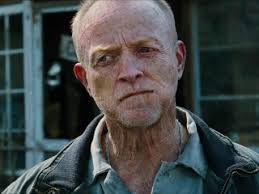
The dénouement has the Joker and Virgin in the bottom level of the facility, the stone room with the carvings of each member of the sacrificial band, that fills up with blood as they die. They are met by The Director, played by Sigorney Weaver. I don't know why, really. It works. But maybe just because she's in every other movie these days. But there she is, explaining the function of the place and their sacrifice, and why Virgin must shoot the Joker. The Virgin does seem about to do so, following the injunction of the maternal authority figure, but is attacked by a werewolf (shadow masculine?), allowing the Joker to attack the Director, who is then axed in the head by the one armed Pain Worshiping Backwoods Zombie daughter (her arm was eaten off by her family, if I remember right), and Joker tumbles them both into the void where the Old Gods are getting pissed. The two then sit back and smoke a spliff, deciding to let the whole thing go to hell (literally), and the last scened has a giant God Hand erupt through the cabin, fade to black, and end of human world.

Ok. Breath. Pause. One more breath. Ok, so, what was all this about, anyway?

What it was not was an exercise in postmodern meta-commentary, in the way that "Rubber," the film about a homicidal desert tire, was. It's not that clean. None of Whedon's productions are that clean or focused. "Cabin" seems to have levels of meaning and levels of the artists' understanding of those levels of meaning.

At the top is the exercise in deconstruction, the wry and ironic commentary-in-motion on the structure and function of modern teenage horror films. The archetypal characters are all presented, and put in the standard encounter with "objects from the past." I think the best reading of these genre films (and actually, much of genre film in general) is as the experience of modern minds and identity looking back at previous developmental levels and, not having yet stabilized the integrity of the modern mind (think here of WWII), looks on the last developmental level as a consuming, rapacious, heartless and cruel entity. How do you deal with the anxiety of this transition in the modern mind? In horror films, it's through and as these ritual sacrifices, tossing the young and weak to the monster, and leaving the modern aspects of mind to survive and conquer the evil. The Jock (life as physicality), the Whore (life as sexuality), the Joker (life as hedonism), and the Scholar (life as abstracted mind) are consumed, and the Virgin (who is often also sexy, physically competent, smart, and most important, heartful) survives.

That's the pattern. We are moving, culturally, and developmentally, towards more and more expression of what Ken Wilber calls the Integral stage of development, in which all these archetypal forces represented by the different kids are brought together and integrated in individuals. So the most integrated one, we want her to win and mark the way out of these negotiations with the old gods.

But that's the enactment. In "The Cabin in the Woods," the meta level is played out by literalizing this enactment. We see it as a conscious, and consciously presented, act, that has become so conscious that, within the film, it is seen as prosaic and an act of art, divorced from its bloody roots, and outside the film, is known so thoroughly that it can be represented (rather than simply enacted unselfconsciously) and its elements commented on, riffed on, and mocked.

But Joss Whedon can't seem to produce happiness. Every film of his I can think of requires a sacrifice. In Buffy the Vampire Slayer (the series), love, relationship, and some major characters, are regularly sacrificed. In "Serenity," the ship pilot is crucified on a huge stake. "Dr. Horrible" has the sweet, wounded super villain killing his love object and actually becoming an embodiment of Evil. There's really no transformation or triumph in his work, or at least none that's not tempered by a blood sacrifice.

Down a level from the postmodern critique and fun is a kind of despair at the possibility of escaping and transforming the past. In "Cabin," the horrific past has been mollified through negotiations that ritually destroy life each year rather than literally destroy life (again, think of WWII). The Old Gods have not been understood and integrated, and thereby transformed and detoxified. Rather, they have been paused, and it's only time till they emerge and consume.

That's a bleak psychological model of human life. There has been development, of course, but only in the technological realm. From virgins being pitched into the volcano, there are now high tech rituals, sanitized and tightly controlled. There's something to be said for that, and for, given the alternative, keeping the catastrophic forces of destruction sedated. But it's not stable, and that's what the Virgin and Joker respond to ultimately in allowing the culture that's based on the consumption of its young to be consumed. Within the film, it makes its own sense.

But the meta to this meta film is this bleak picture of the heart of humans. Negotiation with evil, rather than its transformation; codification and sanitization of one's relationship to that evil, rather than integration and transcendence. Fuck it, the film says in the end, this is the system and it's all that's available, so let it burn.

At the end of the day, it's an adolescent's world view, which makes the Nine Inch Nails singing the endcap ("Last") particularly apropos. But there is an interesting strain running through the last part of the film, which adds to the oddness, because it seems to be an enactment, rather than a comment, meaning that Whedon and his director don't seem fully aware of it. Or maybe one is and one isn't and you're seeing the tension. "The world is shit!" "There is hope!" and they never worked out a resolution.

Because one wonders, why now, why are all the world's rituals failing during the same year? Why are the Japanese children able to, collectively, sing the evil spirit into a bowl of flowers and safely contain it in a cute frog? What did they do right? Did they find out, genuinely, how to transform evil in a way the ritual engineers can't conceive (there's a great image of Richard Jenkins telling the little girls on his monitor, "Fuck you, and you and you!"). These girls are not negotiating with the Old Gods, but rather, besting them. And then there's the oddly explained and not-explained failure to collapse the exit tunnel (until Jenkins manages it at the last moment). The implication is that someone or something prevented it. Why?

In other words, it's not as simple as, say, "Natural Born Killers," which Oliver Stone described as his "fuck shit up" movie. It's not simply glee in tearing down the parent's institutions and status quo, or a triumphant return of the body to what has become a bloodless (clean, modern, stainless steel) exercise that itself simply hides the awfulness of "the before." There's an odd, seemingly un-self aware, strain going through "Cabin" that reminds me a bit of the early Disney films, in which one group of artists tried to present life in the raw, and another life as we'd like to see it (watch Bambi and you'll hear Bambi's mother get murdered by men, and then it cuts to butterflies and lurid colors of Spring).

I have little tolerance for tragedy as a life view; as the astrologer Caroline Casey has pointed out, there's always a 4th act. After King Lear dies, life continues. Some peasant off over that hill has a great crop of lettuce come in, and celebrates with life-affirming orgasms with his wife. "Cabin" would be an adolescent throw away if it were only that, or if it were as left-brained in its deconstruction of the genre as "Rubber." Thankfully, it itself is not bloodless, and exhibits a rich confusion and dis-orientation in its own right that belies the preciousness of the conceit. There's something disturbing in the guts of this film, which mirrors the disturbance in the age we're traversing, and that's what makes it keep echoing out long after the popcorn is gone.

Wednesday, July 9, 2008

"Wanted": logic, depth, and morality...oh, what the hell, it's fun


(Be Advised - SPOILERS)

"Wanted" is a film you really shouldn't like or tolerate, but it's really too goofy and stylized to give much to react to. Sure, the opening few minutes has six humans getting bullets through their heads, some in slow motion with beautiful hand crafted chunks of metal. And sure, there's probably 50 or so deaths to follow, including several ordered by an elaborate sweater-making machine. But it's all so ridiculous and odd and well done that it's hard not to at least wink at. Plus, if you were at all a nerdy, picked on 13 year old boy, the wet-dream fantasy of it is hard to put away with smug adult rationalizations.

I mean, who wouldn't want to be picked up by a uber sexy femme fatale, included in a fraternity (I never got to be in a fraternity, and the one party I ever attended at a frat house, I wore the wrong clothes and got mocked), shown how to fight and shoot cool guns, and then gets to shoot real people because a loom told you to.

That's actually about the whole story, except for the betrayal and final retribution. The structure of the movie is actually exactly that of a typical first-person shooter video game. The protagonist is plucked from his normal, drab life and given an orientation (the training period where you learn the controls and weapons). Then you have a number of unrelated challenges, here, two assassinations. Then you go after the hoards of minions, being the beautifully shot mill shootout. Then the henchmen are taken one by one in protracted fights. And finally the showdown with 'the big boss', being Morgan Freeman. (I'd love to go mano-a-mano with Morgan Freeman.)

If you saw the director's Russian films, Day Watch, etc., you'll remember the odd Hollywood-through-Russian-Eyes aesthetic: slightly muted color palette, stylized camera movements, shifts in speed, and baroque violence. And a physics engine (that's a term from video games, for non-geeks) that's half-way between here and Wiley E. Coyote. Which means, they make an attempt at explaining the magic in terms of physics--the cars form a wedge and he flies in the air; the arm is whipped in a certain way and the bullet curves--but it's basically just to look cool.

But though there are all the elements of a Western Hollywood film, there's still something just odd and foreign about the production. There are all the Hollywood icons, the chases, the wish fulfillment for thirteen year olds, but it's like an early Beatles tune played on a Sitar: there's odd over and under tones even though the melody is the same.

And just like there's a nod to real-world physics, there's a nod to real-world morality. The director strikes me as more sterilized version of Lars von Trier, a man with a masterful sense of film as a technical and stylistic medium, but the moral sense of a pre-adolescent. The morality of "Wanted," like the logic of the story, has to be seen from a certain precious angle, like that sculpture of the impossible box. It's that wire frame box that can't exist because the edges interweave, but when viewed from just the right angle, appears like a living paradox. But you step away just a bit, and the illusion is clear.

There's not much wiggle room in terms of where you stand to view the morality of this film. And the logic has as narrow a perspectival tolerance. Heather brought up the unraveling point that the loom, while it does name names, doesn't tell you what to do with the names. Maybe when Joe Smith is spelled out in binary code of missed stitches, it means go give the man a kiss. Or money. Or love to convert him from his evil ways. How did the interpretation, a 1000 years ago, that you had to kill the loomed-named, how did that triumph? Did the more compassionate weaver have to leave the room to piss during that debate?

Anyway, it's pretty irrelevant, because the director seems to not really care whether you see the illusion of it all--dare I say, threadbare quality?--because the illusion is so obvious within the frame of the film, and the little winks and nods are, um, woven into the tapestry of the film. Like in the big operatic/Matrix-ic factory floor shoot out, there's all these flourishes that play out as, "Gee, isn't this fun?!" The protagonist grabs guns out of the air from dying minions, then shoots a henchman (remember the video game sequence of challenges?) through the head and commences to carry his body as a shield, hanging off the gun that now is embedded in his head, and shoots other minions as he continues to run through the battle. Now that is, well, gross, but totally cool!

Then end has our protagonist being neither the Mariner nor the Wedding Guest from the "Rime of Ancient Mariner": he's neither relieved of guilt by sharing his story, nor sadder but wiser from hearing it. He's Wiser and Butcher, and Morally Finger Pointing to boot. His last line, after describing how he's taken back control from the Big Boss (by shooting him through the head in the same way as his father was killed) and looks at the camera, asking us what we've done lately. It's hard to think that the film would put me sitting with a distressed client, or Heather interviewing to work with under-privileged urban youth, in the same category as murdering a bad guy. But then, after he shoots the bad guy and has to go take a crap, whose going to fix his toilet if it's broken?

Saturday, June 7, 2008

Zohan!


(Be Advised - SPOILERS)

After our swing dance class last night, with our perky Swedish instructor Cat ("tree-pull step!"), we went to see You Don't Mess with the Zohan. I wasn't expecting much. Adam Sandler has had about one good movie and one half-funny movie (Punch Drunk Love, and Anger Managment), and a lot of dumb-ass productions, like drawn out SNL skits.

But this was not only funny in an outrageous but not heavy-handed or contrived way, it was actually very sweet. Sandler's clueless superhero Zohan, an Israeli counter terrorist agent who apparently usually works on his own because he doesn't really need anyone else (he catches bullets in his teeth and up his nose, and sticks a piranha down his pants without flinching), comes to realize that he's tired of all the fighting, and longs to go to New York to be a hair stylist. OK, funny setup which could play the macho Israeli male stereotype against the male stylist stereotype--which does get some play, but Zohan is so sincere and unaware of the stereotypes, without irony, that he comes across as rather clean and pure. When he talks with the young man whose mother takes him in, and whose mother Zohan quickly starts screwing, he sincerely tells the son how happy his mother is and how could he want anything different (apparently in Israel there's no such thing as the primal scene, i.e., walking in on your parents having sex). And he really means it, and you believe it totally. There's really not a wink-wink nod-nod in relation to Zohan. You are expected to take him at his word.

Thus what we get is something of a checking of the American ironic stance via this foreign transplant, who doesn't even understand irony and is fearless about his own sincerity. When he starts seeing hair clients, little old women from the neighborhood, and adds a little shagging at the end of his hair care, you get the sense that he really and truly appreciates these women whom American culture (and American film culture) view as hags or sexless wisdom figures. Zohan sees an inner quality of beauty and lustiness that is so obvious to him, that you start actually seeing the obviousness yourself. It's in this way that the film really tweaks some of the dehumanizing that goes on in American culture.

Not to mention what Zohan is doing with the Middle Eastern conflicts. It's essentially a pacifist and humanistic film. All of the characters (except the evil-doing mall developer and his hick-terrorist hireling) have dreams of a better life, free from conflict and inherited hatreds and divisions. The super-terrorist The Phantom (played wonderfully by John Turturo) secretly wants to sell shoes. His hatred of Israel is something given to him, and forced on him by circumstance; essentially, he wants to live a useful, joyful life doing something he loves.

Same with Zohan, the master soldier, who is tired of the constant fighting and wants to make the world "silky smooth." He also wants to serve others, not support division and dis-integration. He also wants to find his own internal integration, where he does not have to choose only one incarnation of himself, the soldier, over the lover or the servant or the artist. He is tired of only choosing a part of himself, and having his culture insist on only that part.

So in a sense, the film is upholding a cherished, and older, value of America, that you can come here and shed the Old World--the cultures of rigid relationships and inherited animosity--in favor of a life of opportunity. However, here's where the film updates this story to one of not Horatio Alger-like rising to the top, not a narcissistic climb over the bodies of your fellows, but of self-integration, the expansion of the human community to include all struggling, yearning beings. Even the hick hireling--played by Dave Mathews, in a weird and wonderful casting decision--is not killed in the end, but rather catapulted by the combined, uh, singing of The Phantom and Zohan--never done in 2000 years!--into the gay party helmed by George Takai (nee, Sulu from Star Trek). Even he is given an opportunity to face his fears through exposure to the feared community, which presents itself as both wonderfully idiosyncratic and totally human.

I am such a sucker for such films, because I so believe in and yearn for this deep healing and recognition of connectedness. And I love the archetypal nature of pop culture, how it can express in simple terms deep longing and hope. And I really love genre literature and art, in its both honoring the structure/tradition/community of life, as well as the joyous reinterpretation of that life by the artist, a conscious expression of what we all do all the time.

So, the reason why "you don't mess with the Zohan" is not actually that he's so tough and macho, it's because his essential nature is loving, and there's no way to fight that.

Sunday, May 25, 2008

Indy!

Well, pretty flaccid and tired. I said to James, it was like after making Schlindler's List, how can you get that impassioned about another rehash of trashy early-century serial dramas? I hope the filmmakers and actors had fun with each other, because I came out feeling battered and without memories of anything...memorable.

Here's Fresh Air's spot-on take on the movie, here.

Sunday, April 13, 2008

Beowolf - Look how much that's going to cost!

(Be Advised - SPOILERS)

I was watching the last part of the recent film "Beowolf," with my clients at the halfway house. It's a clever high-tech hybrid of real actors and computer animation, and tells the story of King Beowolf and his travails. The climactic scene is him battling his son-cum-dragon, who is rampaging across the country burning villages and so forth. He goes after Beowolf's concubine and wife, who are standing on a stone walkway between two high towers. Of course, the dragon burns chunks out, bites other chunks, all but destroying the construction. Earlier, he burned a wood bridge across a chasm.

So where does my mind go? To think, who's going to repair that? What a waste of workmanship! All the drama is nice and all, but in the long term, some poor group of schmucks are going to have to do a lot of heaving and hauling to get the bridge up, the walkway reconstructed. Probably some will get injured or fall. The kingdom's coffers are going to be drained for the construction, and resources that otherwise could have built infrastructure have to go for these repairs.

Oh, how easy it is to destroy, how difficult to build...

Friday, March 14, 2008

Dogville

(Be Advised - SPOILERS)

There is something utterly disgusting about Lars von Trier's "Dogville," which is belied by the richness of production and the sheer weight of acting talent. It's the story, shot as a play without an audience, of what seems to be a gun moll escaping to a small Colorado town for refuge. The town slowly plays out its suffering on her, like a J.G. Ballard story, where the human race slowly devolves into its most primitive forms. She turns out to be the daughter of a mafioso, and she orders the execution of the whole town in the film's finale.

But the disgust is not in the story, it's in the sheer adolescent arrogance of the director, in his pompous and supercilious dismissal of human weakness. The end montage, of America's downtrodden, is really horrific to see, like some Versailles aristocrat pointing out their window at the suppurating peons in the slums below. The setup is so easy and yet the payoff so self-righteous, and psychologically stupid.

The film sketches certain moral issues, about responsibility, liberalism, but never plays them out with any integrity. What you get is a cypher for the director to play out his own disgust, to make of the characters what the characters make of the mob daughter: a scapegoat and screen for projection.

Because the production is so skillful, it wasn't till the very end of the film, as the denouement was reached, that the simple point of the film was reached, and the director got to piss on everyone and walk off content. It's like listening to a long, sophisticated speech about race relations, which then ends, "And that's why I hate niggers."

The disgust of the film is supposed to be directed at the morally weak, while in truth its deserved focus is the director himself.